

Why a University Press Might Be the Perfect Home for Your Book
Why writers should consider university presses for debut fiction and memoir--and a list of presses that accept unagented submissions

Michelle Richmond is the New York Times bestselling author of The Marriage Pact, The Year of Fog, The Wonder Test, and six other novels and story collections.
If you’ve written a story collection or a debut novel and tried to find an agent or publisher, you know how challenging it is to break through. In this post, I’ll share why I love university presses, and how to know if a university press is a good fit for you. You’ll also find a list of university presses with an annual book contest.
Do university presses accept unagented submissions?
Yes, many university presses accept unagented submissions of literary novels and story collections. One way they do this is through annual literary contests that offer publication of the winning manuscript. In this post, you’ll find 16 university presses that publish literary fiction by new and established writers.
Why I believe in university presses
I’ve published six novels and two story collections, with a seventh novel on the way. Both of my story collections were published by university presses through an annual contest. While it’s rare for a big publisher to accept a story collection by an unknown author, university presses often publish debut collections and debut novels by unknown, un-agented writers. The publication contracts often arise from an annual contest sponsored by the university press or its affiliate.
Major publishers, of course, operate for profit. They have to make money. While they won’t make a profit on all of the books they publish, their goal is to keep the doors open, keep paying their staff, and be profitable as a business.
University presses, on the other hand, work on a different model. Profitability is less important than publishing work that fits the press’s mission. Traditionally, university presses are subsidized by the university, and they have a very small staff. As long as they have the support of the institution, they can keep the doors open. This makes university presses an important launching point for literary fiction. Although many university presses concentrate on nonfiction, quite a few publish fiction, especially through annual literary prizes.
Should you submit your book to a university press?
The answer is yes if:
You have a completed short story collection, and several of the stories have been published in recognized literary journals. Whether or not you have a literary agent, a university press may be a great fit for your story collection.
You’ve completed a literary novel, and you don’t have an agent.
You have a book with a strong regional connection, and you are an alumnus of a university with a press that publishes books focused on that region.
You have an unpublished literary novella. Again, a university press may be a good fit whether or not you have an agent.
University Presses Accept Unagented Submissions
One of the most attractive aspects of university presses, and many small presses, is that they accept un-agented submissions. Although advances are small, university presses can get your book in front of reviewers.
The advance from the university press that published my first book, a linked story collection, was $1,000. The book sold fewer than 2,000 copies before the rights reverted to me (a university press will often allow you to regain rights at no cost to you if you ask for them). Despite the small advance, the press got my debut story collection reviewed in The New York Times, The Boston Globe, the San Francisco Chronicle, Publishers Weekly, Library Journal, Kirkus, and many newspapers. That didn’t put food on the table of the one-bedroom apartment in the building I was managing in San Francisco’s Castro district at the time, but it’s not nothing. There’s no way I could have gotten that review attention without a publisher.
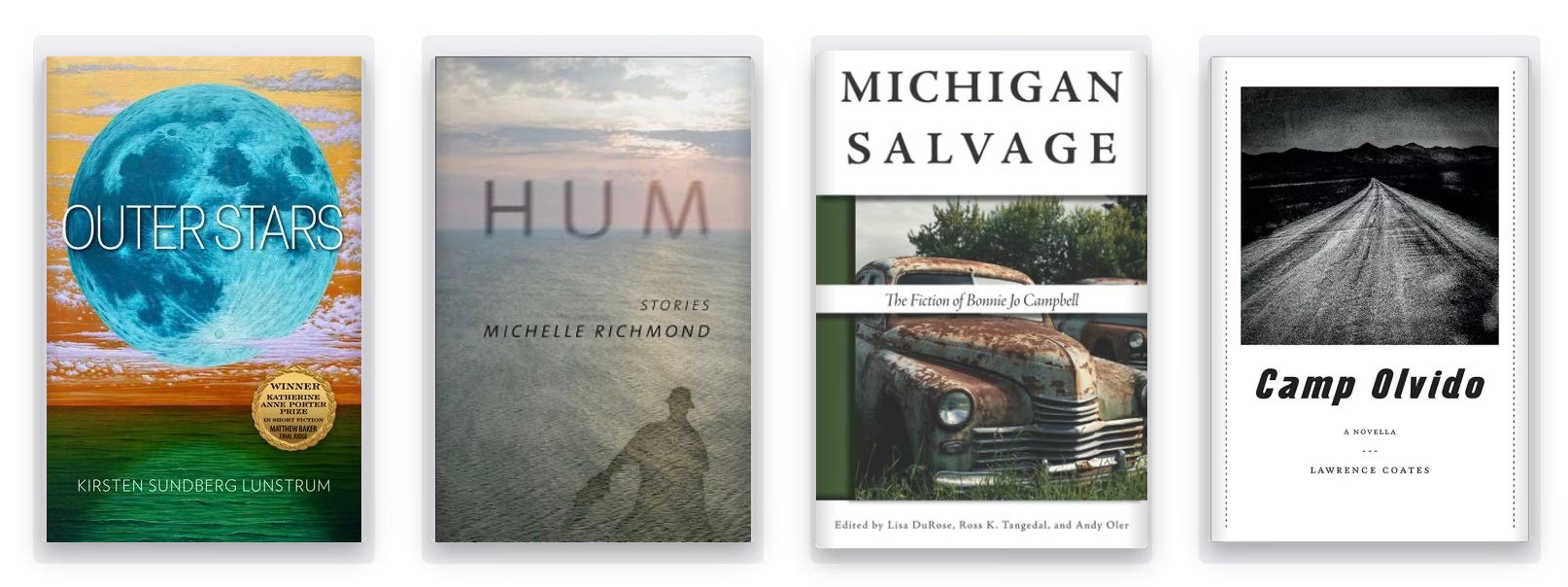
University of Alabama Press, in conjunction with the long-running small press FC2 and their Catherine Doctorow Innovative Fiction Prize, published my second story collection, Hum. Even though I had a few novels under my belt by then and I was under contract with Random House for a novel, they weren’t interested in publishing my short stories. I don’t really blame them. Short story collections do tend to be harder to sell than novels.
Hum didn’t exactly fly off the shelves, but I loved that book and was happy to have it out in the world. UA Press did a beautiful job with it, and they even included a forward by Rikki Ducornet (yes, that Rikki), who was the judge for the literary contest The icing on the cake is that I received my undergraduate degree at the University of Alabama, so the publication felt a bit like coming home.
University presses are a great fit for debut story collections, novellas, and literary fiction by writers with a solid body of work.
Although novellas are having a moment, until recently, big publishers mostly shied away from novellas, preferring longer works. In addition to being a proven launching pad for debut fiction, university presses can provide a home for literary fiction by established authors—especially novellas and story collections.
One of my favorite California writers, Lawrence W. Coates, released the award-winning novella Camp Olvido through Miami University Press. He has also published several novels with University of Nevada Press.
A university press can provide continuity and a home for one’s work, particularly when that work is of high literary quality and doesn’t easily fit into a mainstream commercial genre.
Other critically acclaimed writers whose work has been published by university presses include
Bonnie Jo Campbell—American Salvage, Wayne State University Press and Michigan Salvage, Michigan State University Press
J.M. Coetzee—The Lives of Animals, Princeton University Press
David Jauss —Black Maps, University of Massachusetts Press
Renee Sims—Meet Behind Mars: Stories, Wayne State University Press
Kirsten Sundberg Lunstrum —What We Do with the Wreckage, University of Georgia Press, and Outer Stars, University of North Texas Press
University Presses that Publish Fiction
And here is a list of university presses that publish fiction, with links to submission guidelines. For presses that host an annual contest with a prize of manuscript publication, I’ve included contest link.